
Is Your Power Bill a Fair Deal? Introducing Our Free Bill Review
Your bill only compares you with your own retailer's plans. Upload it and, for free, we price every plan published for your address on your actual usage and give you a plain-English verdict.
From 1 July 2026, the regulator's reference price for NSW households fell by between 3.4% and 5.0%. That doesn't mean your bill came down with it. What you pay depends on the plan you're on, and it's easy to stay on a plan long after it has stopped being competitive.
That's why we've launched the free Power Bill Review. You upload your latest electricity bill, and our system reads it, prices every plan published for your address on your actual usage, and gives you a report page of your own on whether you're getting a fair deal. It's free, we take no commission from any retailer, there's no site visit, and it covers NSW, the ACT, Queensland, South Australia, Tasmania and Victoria.
Your Bill Only Compares You With Your Own Retailer
Under the Australian Energy Regulator's Better Bills Guideline, your retailer has to put a 'Could you save money on another plan?' message on the front page of your bill at least every 100 days. It's a useful prompt, but read the wording closely. The comparison is with the best plan that retailer can offer you, so a message saying 'you are on the best plan we can offer you' tells you nothing about what other retailers charge.
Comparing the wider market yourself means working out your usage, tariff, supply charge and any solar credits, then lining them up against other plans. It isn't hard if you know what you're looking at, but most people never get past the amount due and the due date. The Power Bill Review does that comparison for you and explains it in plain English.
What We Check on Your Bill
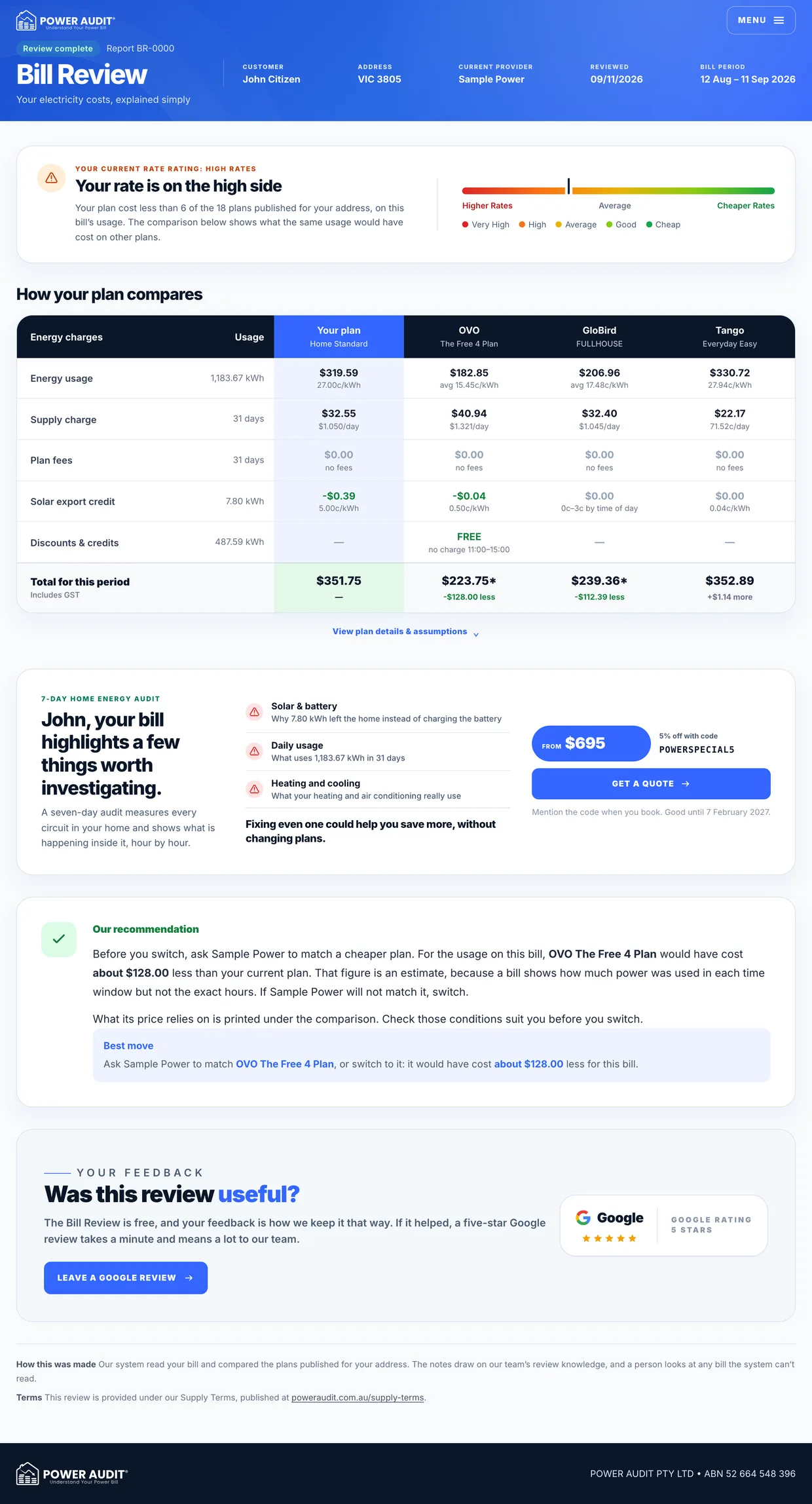
Your review covers the parts of the bill that decide what you pay:
- Usage rate: what you're paying per kWh, and how that compares with other plans on the market.
- Supply charge: the daily fee you pay before you use any power, and whether it's working against you.
- Tariff type: whether your tariff suits how your household actually uses power.
- Time-of-use split: if you're on a time-of-use tariff, how your usage falls across peak, shoulder and off-peak, and whether shifting it would be worth the effort.
- Solar credits: if you have solar, whether your feed-in rate still stacks up.
- Concessions: rebates or concessions that look like they're missing from the bill.
What Your Report Looks Like
You get a report page of your own, with a PDF to keep. Not a referral to a comparison site. It rates your current rates on a scale from very high to cheap, sets your plan side by side with other plans published for your address for the same usage, and finishes with a plain-English recommendation that starts with asking your current retailer to match the cheaper plan before you switch. If you're already on a good plan, that's what the report will say. Most reports are ready within minutes.
We receive no commission from energy retailers, and we don't switch you over. Your details are used only to complete your review, and you won't get calls from energy companies asking you to change plans. If the best move is a switch, you make it yourself, when it suits you.
Find out whether your plan is a fair deal.
Upload your latest bill and get a free report on every plan published for your address. No commission, no site visit.
A New Plan Worth Asking About: Solar Sharer
This year also brought a new kind of plan. From 1 July 2026, NSW households with a smart meter can opt in to the Solar Sharer Offer, which includes three hours of free electricity between 11am and 2pm each day, whether or not they have solar panels. The trade-off is that power used outside the free window costs 1 to 4 cents per kWh more than the matching time-of-use offer.
The regulator says the offer is best suited to households that can shift their usage into the free window. If your washing machine, dishwasher, pool pump, hot water or EV charging can run in the middle of the day, it may be worth a look. If most of your power goes on evening cooking, cooling and heating, the higher rates outside the window could leave you worse off. How well your tariff suits the way your household uses power is part of every review.
Bill Review or Home Energy Audit?
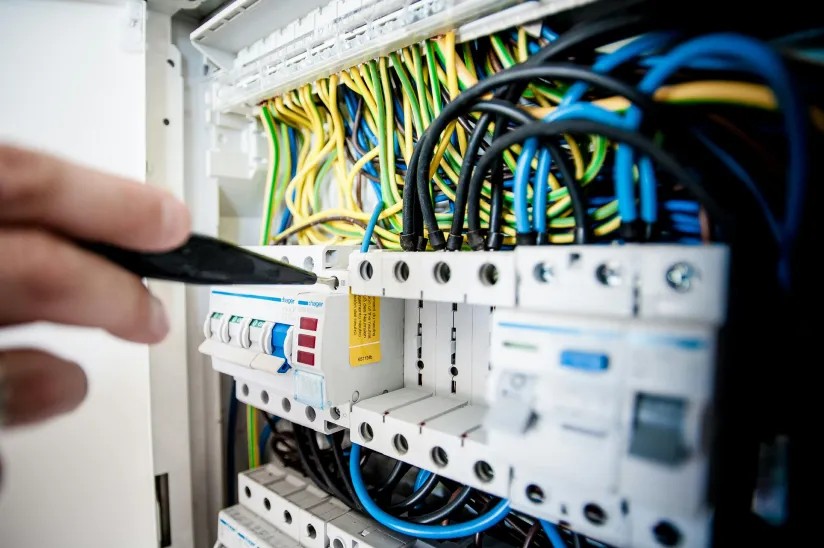
The bill review is desk work on the bill you already have, and it answers one question: are you paying too much for your electricity? Our home energy audit answers a different one: what is using it? For $695, we put monitoring on your switchboard for seven days and break your usage down circuit by circuit, so you can see what your air conditioning, hot water, pool pump and always-on appliances are really costing you.
If your rates look fair but the bill is still high, the problem is usually how much power the house uses, not the price you pay for it. That's when an audit earns its keep. The bill review covers NSW, the ACT, Queensland, South Australia, Tasmania and Victoria; the home energy audit is for NSW homes only, and your bill review report carries a code for 5% off it.
How to Get Your Bill Reviewed
It takes about five minutes:
- Your details: your name, email and postcode, and three quick questions about your smart meter, solar and battery.
- Your code: we email you a six-digit code, so there's no password and no account.
- Your bill: a PDF, or up to ten photos of your latest electricity bill, front and back if the usage breakdown runs over. You can email yourself a link to carry on from your phone.
- Your report: a page of its own with a PDF to keep, most ready within minutes. No payment details are asked for at any point.
One tip before you upload: if you hold a Pensioner Concession Card, Health Care Card, Low Income Health Care Card or Veteran Gold Card, check that your retailer knows about it. In NSW, the Low Income Household Rebate is worth up to $285 a year, but retail customers have to ask their retailer to apply it. If a rebate looks like it's missing from your bill, your report will say so.
A bill review won't change how much power your home uses, but it can stop you paying more than you need to for the power you do use. It's free, and it's a quick, straight answer from a team with no plan to sell you.
Sources
When the bill still does not make sense, start with measured data
A cheaper plan can reduce your rate, but it will not explain what is creating the usage. PowerAudit gives you circuit-level visibility, a clear report, and prioritised next steps for your actual home.